
AI+X Research Program
Be the primary author of your own ideas
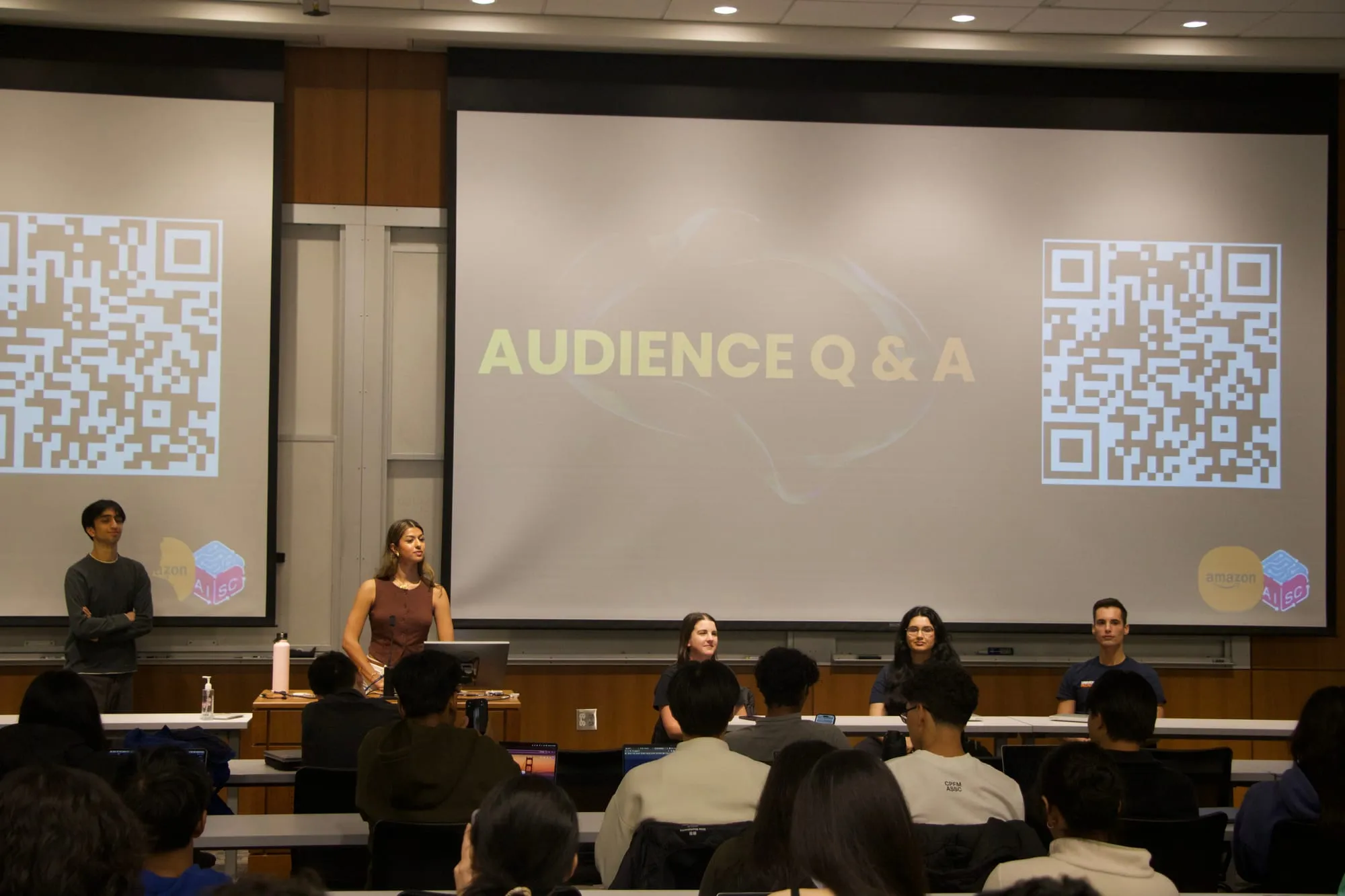
The first ever student-led research program at UW. Small teams take a problem from a field they care about, bring AI into it, and write a paper aimed at an IEEE conference, following a curriculum designed by board members experienced in research. Two quarters, start to finish.
- Length
- Two quarters Fall 2026 and Winter 2027
- Curriculum
- Designed by our board Board members experienced in research
- Time
- Around 4–6 hours a week to confirm
- Guided by
- A team lead Main point of contact, start to finish
- Next step
- Applications open Sep 30 Apply on your own or as a team
Why apply
-
Your own ideas, with your name first on the paper
Teams pick their own research question and lead the work from start to finish, with a curriculum built to take them from idea to paper.
-
Doors to incredible professional opportunities
Research puts people in touch with labs, professors and the AI Collective’s global network, and that’s where research positions, internships and strong recommendations come from.
-
Credentials with depth
A published paper puts a name on the record in a field. It shows grad schools, labs and employers that someone can take an idea all the way to work that holds up under peer review.
The goal
Our goal is to get each team published at an IEEE conference
Experienced team leads guide participants through the publication process
The curriculum was designed by board members who know the research world from the inside. Every team also has a lead who has published and works in a lab. They’re the main point of contact, and they guide the team through each stage of it:
- Ideation
- Methodology
- Paper writing
- 3
- IEEE conference papers co-authored by our board
- 682
- full-text downloads on IEEE Xplore
- 3
- fields: finance, AI fairness, biological systems
- 2024–25
- every paper from the last two years
Our board’s papers
- Novel Cash-Flow Based Underwriting Model using Gradient Boosted Decision TreesMihit Puvvula (lead author) and 2 co-authors · IEEE AIxB 2024
- Quantifying Bias in Agentic Large Language ModelsHasan Wazir and 8 co-authors · IEEE ICTC 2024
- A Time-Step-Based Neural Network Framework for Modeling Chaotic DynamicsMohit Kumar and 10 co-authors · IEEE ICBBT 2025
Two kinds of paper
Every paper in the program is one of these.
-
A new method
Taking an AI technique somewhere it hasn’t been tried for that problem, and showing it beats what people use now.
-
A new space
Bringing AI into a field that hasn’t really had it yet, and opening up a new topic of discussion there.
Cohort 1 leans towards bio and health and computing and tech, but any field works: econ, linguistics, physics, whatever. If there’s a dataset and a question that can be measured, it works.
Program details
- Curriculum
- Designed by our board Board members experienced in research
- Guided by
- A team lead Main point of contact, start to finish
- ML help
- ML leads For implementing methods in experiments
- Network
- The AI Collective, globally to confirm What participants get from it is still being settled
- Time
- Around 4–6 hours a week to confirm
- Length
- Two quarters Fall 2026 and Winter 2027
Timeline
- Starts Oct 26 Kickoff
- Week 3 Ideas locked in
- Week 7 New model or framework built
- Week 10 New developments wrapped up
- Week 14 Paper finished, publication options discussed
- In March The symposium
Winter break doesn’t count toward the weeks.
Applications open Sep 30
- On your own or as a team
- Written application
- Interview
Keep an eye on our Instagram and LinkedIn for when it drops.
Questions
Can I apply on my own?
Yes. Apply on your own and we’ll match you with someone interested in a similar problem space. You can also apply as a team.
What if I don’t have an idea yet?
You don’t need a finished idea, but you do need a direction. Pick a field you care about and read into it until you can name a problem you’d want to work on. Your team lead helps turn that into a research question during ideation, so bring a real interest, not a placeholder.
How much time does it take, and can I balance it with classes?
The curriculum was designed around the UW calendar, so exams, dead weeks and official holidays are built into the schedule.
Is publication guaranteed?
No. Peer review decides that. What we do is make sure every paper is built to IEEE standard.
Why IEEE?
It has conferences for pretty much every field in the program, the standards are high but a strong undergrad paper can meet them, and people recognize the name.
Would rather build than write?
Project Cycles puts you on a small team that ships a working project by Demo Day.